New Tallest Virgin Mary Statue in Rural Poland Can Be the Next Tourist Destination
A tiny Polish village with fewer than 150 residents has suddenly gained a landmark that is almost impossible to ignore. Konotopie, a quiet rural community in central Poland, is now home to a 182-foot statue of the Virgin Mary, making it the tallest monument of its kind in Europe.
The enormous statue rises above open fields near a small local chapel, creating a striking contrast with its peaceful surroundings. Located about 100 miles northwest of Warsaw, Konotopie could soon attract pilgrims, architecture fans, curious travelers, and visitors searching for places far beyond Poland’s usual tourist routes.
Europe’s Tallest Virgin Mary Statue Has a Huge Presence
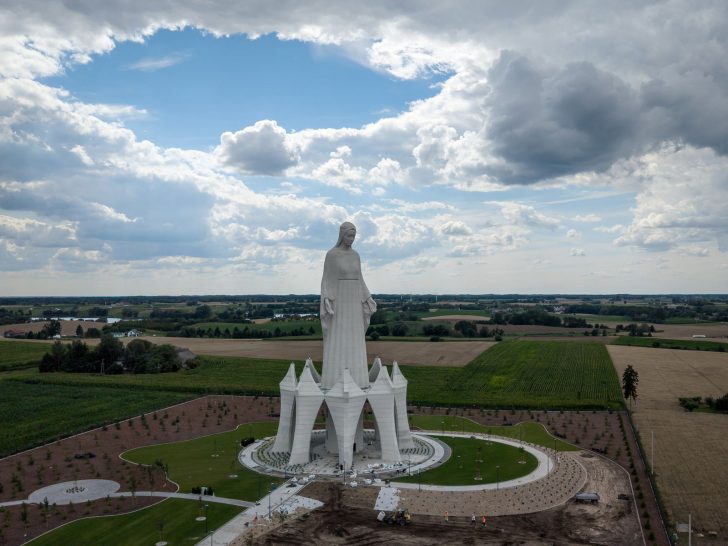
Travel Tomorrow / The Virgin Mary statue in Konotopie reaches a total height of 182 feet. The statue itself measures 133 feet, while the crown-shaped pedestal underneath adds another 49 feet to the monument’s impressive overall height.
Those measurements place the monument above several religious landmarks that are already famous around the world. Rio de Janeiro’s Christ the Redeemer measures roughly 124 feet when its pedestal is included, while Poland’s Christ the King statue in Świebodzin reaches about 170 feet from its base to its highest point.
The Konotopie monument also carries a deeply personal story behind its enormous scale. A wealthy Polish couple, Roman and Grażyna Karkosik, commissioned the project and funded the entire construction, reportedly spending around $26 million on the concrete and steel structure.
Roman Karkosik built his fortune through manufacturing and investments and ranks among Poland’s wealthiest business figures. The couple has described the monument as an expression of gratitude to God, giving the project a religious purpose that reaches beyond records, measurements, and impressive engineering.
The location makes the monument even more unusual because Konotopie is far removed from Poland’s busiest tourism centers. Visitors usually associate the country with Warsaw, Kraków, Gdańsk, or historic sites such as the Wieliczka Salt Mine, rather than a tiny village surrounded by farmland.
A Dramatic Ceremony Put Konotopie in the Spotlight
The monument was consecrated on August 15, 2026, during the Feast of the Assumption of the Blessed Virgin Mary. The date carries major importance in the Catholic calendar, making it a fitting choice for the formal opening of such an ambitious Marian monument.
Hundreds of people attended the ceremony, turning the small village into the center of national attention for the day. Bishop Krzysztof Wętkowski of the Diocese of Włocławek led the Mass and spoke about the statue as a reminder for people to raise their eyes toward God.
Former Polish president and Nobel Peace Prize laureate Lech Wałęsa also attended the ceremony. The 82-year-old reflected on the importance of Mary throughout his life, telling the Associated Press that he “started with the Virgin Mary and ended with the Virgin Mary.”
The ceremony also included an unusual spectacle that matched the scale of the new monument. Helicopters circled above the gathering and released miniature red roses over the crowd, adding a dramatic visual moment to an event already drawing considerable public attention.
The statue’s importance could extend far beyond its inauguration because Poland has a strong Catholic identity and a long tradition of Marian devotion. Religious destinations such as Jasna Góra in Częstochowa already draw large numbers of pilgrims, showing that faith-based travel remains a significant part of Polish tourism.
Could Konotopie Become the Next Tourist Destination?
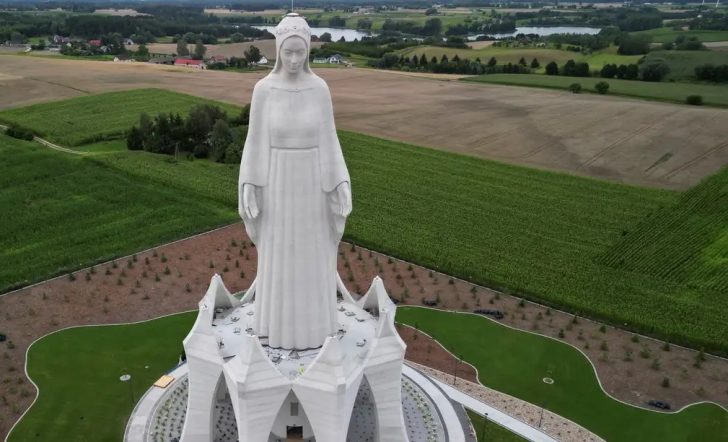
AP / The Karkosik family said that the monument is “meant for everyone” and expressed hope that visitors will use their time there to reflect more deeply on their lives.
The design also gives tourists a reason to stay longer than a quick roadside photo stop. Inside the crown-shaped pedestal, visitors can access a viewing terrace that provides wide views across the surrounding countryside, turning the monument itself into an observation point.
That feature could help Konotopie attract travelers who are interested in architecture and unusual landmarks rather than religious pilgrimage alone.